Mānuka Honey vs Regular Honey: The Science Behind the Price
What separates mānuka honey from supermarket honey: MGO, non-peroxide activity, MPI certification, and why a scientist-beekeeper says the price is justified.

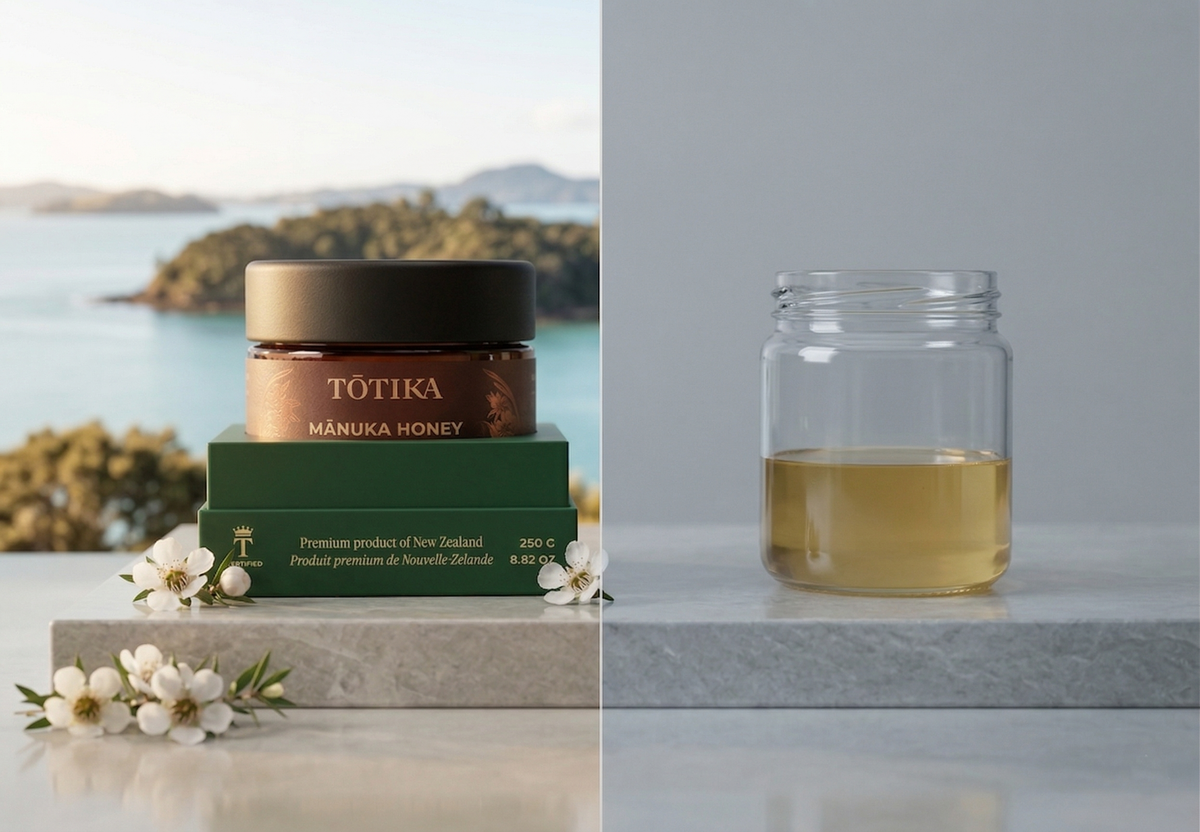
Mānuka honey from New Zealand contains methylglyoxal at concentrations up to 20 times higher than regular honey, giving it antibacterial activity that persists after heat and light exposure. Regular honey relies primarily on hydrogen peroxide, which degrades quickly. The MGO rating tells you exactly how much active compound is present — a chemical precision no other honey grading system matches.
Walk into any supermarket in New Zealand, Japan, or London and you will find two products on the same shelf, both labelled "honey", separated by a price difference that can exceed 2,000 per cent. One jar is amber, runny, and costs a few dollars. The other is darker, denser, and costs more than most restaurant meals. The obvious question is whether the price is justified by science, or whether it is simply the product of marketing.
I have been working with mānuka honey since 2013, when I first began as a design consultant for a beekeeper, designing an eco beehive. What started as a design project became something else entirely. I went on to manage over 150 hives across Northland in the early years, founded and ran the Waipu Bee Club for five years, became a Founding Member of Apiculture New Zealand (FM00007), and eventually built Tōtika Health, exporting certified mānuka honey to the United States, Canada, Japan, China, the Middle East, and multiple European markets. I hold a PhD in Aerospace Materials and an MPhil in Biomedical Engineering. I approach honey the same way I approach any engineered material: by examining what is happening at the molecular level, not at the label level.
The answer to the price question is not simple. It depends on what you are measuring, what you intend to use the honey for, and whether the jar in your hand contains what the label claims. This article covers all three.
What Regular Honey Is and What It Does Well
Regular honey is not a simple product. Raw, minimally processed honey from a responsible beekeeper contains enzymes, amino acids, minerals, flavonoids, and a complex carbohydrate profile. It has genuine antibacterial properties, largely attributable to the production of hydrogen peroxide. When bees convert nectar into honey, an enzyme called glucose oxidase catalyses the slow oxidation of glucose, releasing hydrogen peroxide as a by-product. This peroxide activity gives all raw honey mild antimicrobial characteristics, which is why it was used medicinally long before antibiotics existed.
The important word there is "mild." Hydrogen peroxide activity in honey is real, but fragile. It is significantly degraded by heat, ultraviolet light, and by the catalase enzyme naturally present in human tissue and wound fluid. This means that when standard honey is applied to a wound or consumed and absorbed, its primary antibacterial mechanism begins to degrade almost immediately. Pasteurised supermarket honey, which has been heated to extend shelf life and prevent crystallisation, loses even more of this activity during processing.
Regular honey is also multifloral, meaning bees gather nectar from many different plant species depending on what is available. The resulting honey varies significantly in flavour, colour, sugar profile, and bioactive content from batch to batch and season to season. This is not a flaw; it is simply the nature of the product. For general sweetening, cooking, and everyday use, high-quality raw regular honey is a genuinely good choice, and significantly cheaper for applications where potency does not matter.
The Chemistry That Makes Mānuka Different
Mānuka honey is produced by bees that forage primarily on the flowers of Leptospermum scoparium, a native New Zealand tree commonly known as the mānuka or tea tree. The flowers are small, white (occasionally pink or red), and bloom for only two to six weeks each year. This short window and the remote, often mountainous terrain where mānuka grows are the first reasons the honey is expensive to produce. But the price difference is not primarily logistical. It is chemical.
The nectar of Leptospermum scoparium contains an unusual organic compound called dihydroxyacetone, or DHA. Inside the hive, as bees process this nectar into honey and it matures, DHA undergoes a spontaneous chemical conversion, transforming into methylglyoxal, abbreviated as MGO. This reaction continues during the storage and ageing of the honey, which is why freshly extracted mānuka honey may have a lower MGO reading than the same batch tested six months later.
Methylglyoxal is the compound that sets mānuka honey apart. In a landmark 2008 study, Professor Thomas Henle of the Technical University of Dresden and colleagues identified and quantified methylglyoxal as the dominant antibacterial constituent of mānuka honey, explaining the non-peroxide activity that researchers had observed for decades without being able to identify its source [1]. Unlike hydrogen peroxide, methylglyoxal is chemically stable. It does not degrade with heat, light, or exposure to wound fluid. Its antibacterial mechanism operates independently of the peroxide pathway.
A 2022 study published in PLOS ONE by Green, Lawag, Locher, and Hammer examined 29 commercial mānuka and Leptospermum honey samples from Australia and New Zealand and found a strong correlation between MGO content and antibacterial activity measured across multiple bacterial species and multiple methods [2]. For a deeper explanation of how MGO forms, how it is measured, and what our IANZ-accredited batch results show across grades, see our complete MGO science guide.
Regular honey contains essentially no methylglyoxal in meaningful concentrations. The DHA precursor is either absent or present only in trace amounts in non-Leptospermum nectars. This is not a quality deficit in regular honey; it is simply a chemical difference between plant species.
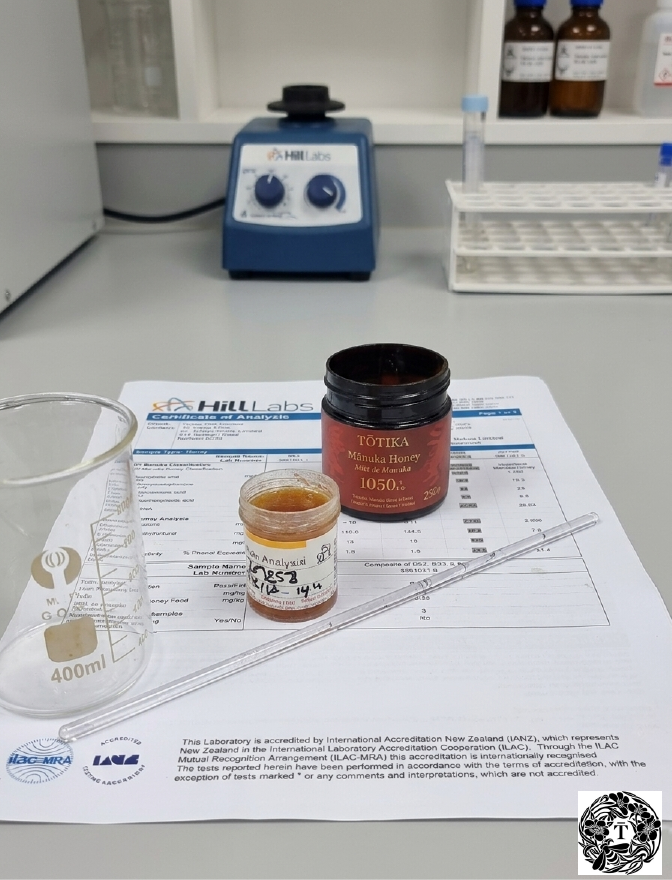
Tōtika MGO 1050+ batch tested at R J Hill Laboratories, Hamilton. Lab No. 3951021, August 2025. MGO 936 mg/kg, DHA 2,740 mg/kg, MPI Monofloral classification.
Leptosperin: the Authenticity Marker That Cannot Be Faked
Alongside MGO and DHA, authentic mānuka honey contains another compound called leptosperin (formally: methyl syringate-3-O-glucoside), a naturally occurring phenolic glycoside derived exclusively from mānuka nectar. Leptosperin cannot be synthesised at a cost that would make adulteration commercially viable, and its presence at defined threshold levels is used by New Zealand's Ministry for Primary Industries as one of the five required attributes for certification as monofloral mānuka honey.
This matters significantly when you are evaluating what you are buying. Methylglyoxal, as the fraud cases discussed below show, can be added synthetically to low-grade or non-mānuka honey. Leptosperin cannot be replicated economically, which is why it was incorporated into the MPI testing protocol specifically as a fraud deterrent. When leptosperin is present alongside appropriate MGO, DHA, and DNA test results, the honey is genuinely from mānuka nectar.
The MPI Five-Attribute Test: What "Certified" Actually Means
New Zealand's Ministry for Primary Industries introduced a mandatory scientific definition for mānuka honey in 2018, applying to all honey exported from New Zealand as mānuka. The standard requires any claimed mānuka honey to pass five separate tests before it can be legally exported under that name.
Four of the five tests are chemical: the honey must contain minimum threshold levels of methylglyoxal, DHA, leptosperin (3-PLA), and hydroxymethylfurfural (HMF, a freshness indicator). The fifth test is a DNA analysis, confirming that the pollen present in the honey is consistent with Leptospermum scoparium, establishing floral origin at the biological level.
A honey passing all five attributes at monofloral thresholds is certified monofloral mānuka. A honey passing some but not all attributes may be classified as multifloral mānuka, indicating a genuine but lower-purity product. A honey failing these tests cannot be exported from New Zealand as mānuka honey under any grade.
As a Founding Member of Apiculture New Zealand (FM00007), I have been part of an industry body whose primary mandate has been bee health and welfare across New Zealand's apiaries, and which represents and advocates for beekeepers at a national level. That experience, working within an industry where hive health directly determines the chemical consistency of what the bees produce, is inseparable from understanding why rigorous testing protocols like the MPI standard exist and why they matter for buyers. Every jar of Tōtika honey is independently tested by an IANZ-accredited laboratory before it leaves our facility.
The Comparison: What You Are Actually Buying at Each Price Point
| Honey Type | Peroxide Activity | MGO (Non-Peroxide) | Leptosperin Present | MPI Certified | Primary Use |
|---|---|---|---|---|---|
| Regular raw honey | ✓ Present (heat-sensitive) | ✗ Negligible | ✗ No | ✗ No | General sweetening, cooking, everyday wellness |
| Multifloral mānuka | ✓ Present | ✓ Low to moderate | ✓ Yes (partial MPI pass) | Partial | Entry-level mānuka; general daily use |
| Monofloral MGO 250+ | ✓ Present | ✓ Moderate (min. 250 mg/kg) | ✓ Yes | ✓ Full monofloral | Daily wellness, gut health support, mild skincare |
| Monofloral MGO 850+ | ✓ Present | ✓ High (min. 850 mg/kg) | ✓ Yes (elevated) | ✓ Full monofloral | Targeted wellness, bioactive skincare formulation |
| Monofloral MGO 1050+ | ✓ Present | ✓ Very high (min. 1,050 mg/kg) | ✓ Yes (highest) | ✓ Full monofloral | Maximum potency; specific clinical and skincare applications |
The table makes one thing plain: the difference between regular honey and certified monofloral mānuka is not a matter of degree along the same scale. MGO is simply absent in one and present in the other. The comparison is between two chemically different products that happen to share the same category name.
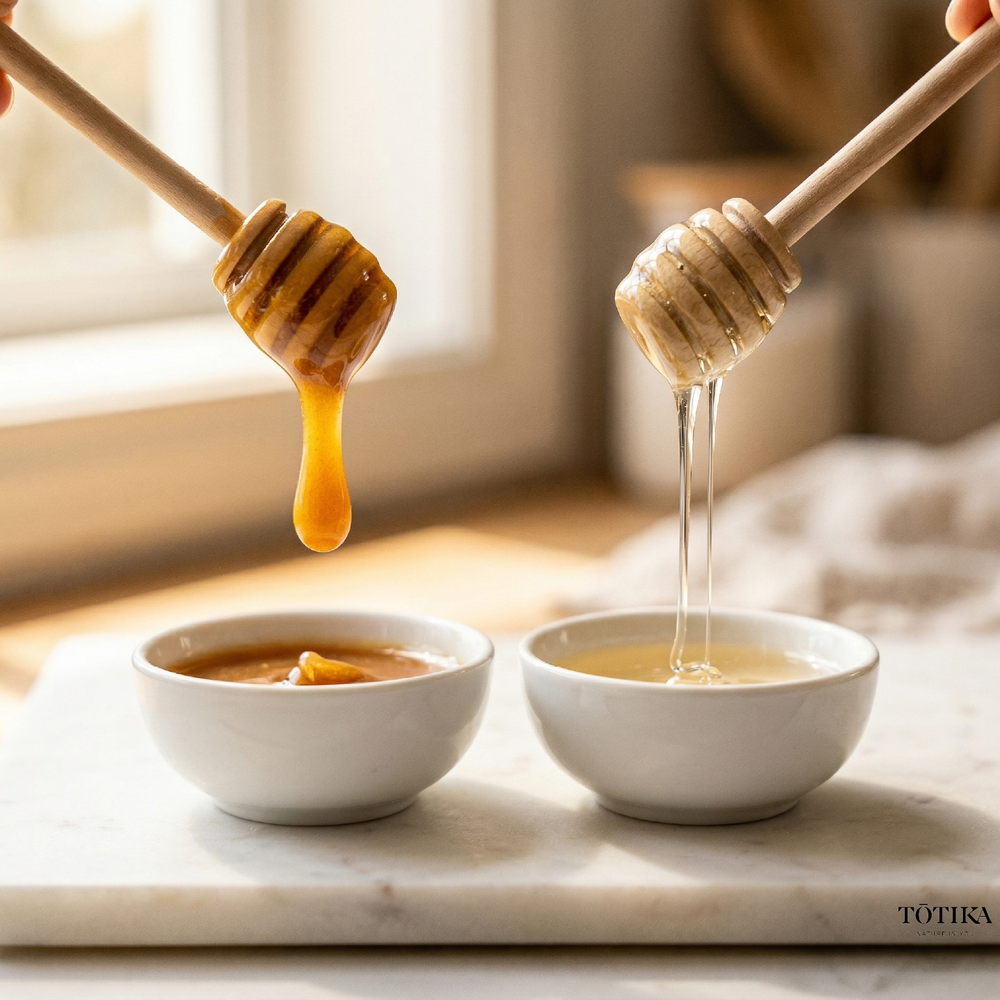
The viscosity and colour difference between high-MGO mānuka honey (left) and standard multifloral honey (right) is visible to the naked eye.
Why the Price Reflects the Production Reality
Having managed over 150 hives in the early years of Tōtika, and having scaled to the point of exporting to ten countries across four continents, I can explain the production economics from direct experience rather than theory.
Mānuka flowers bloom for two to six weeks each year. That is the entire harvest window. If the weather is poor during those weeks, the bees do not forage, the nectar flow is disrupted, and the season's yield drops regardless of how many hives you have positioned. Beekeepers often use helicopters to move hives into dense native bushland to maximise the bloom period, an operational cost that does not exist in multifloral honey production.
After extraction, every batch of mānuka honey intended for export must be submitted for IANZ-accredited laboratory testing. At Tōtika, we test every batch and retain the certificates with batch numbers that can be cited publicly. MPI registration, FDA registration (our number is 16798813536), EU TRACES compliance, China GACC compliance, and the documentation requirements for the Japanese and Middle Eastern markets all represent ongoing regulatory cost that does not exist for domestic regular honey production.
A certified monofloral mānuka honey at MGO 500+ is expensive to produce because it requires a specific plant species with a narrow bloom window, in specific remote terrain, tested per batch by accredited laboratories, and exported under government-mandated documentation. If a product at that grade is priced the same as supermarket clover honey, the explanation is almost certainly not generosity. Browse our full range by MGO grade, with verified batch test data alongside each product.
How to Spot a Fake: the Authentication Guide
Honey adulteration is one of the more serious food fraud problems globally. In 2016, honey was identified as the third most-faked food product in the world. New Zealand's production of certified mānuka honey has never come close to matching global claimed sales volume, meaning a substantial proportion of what is sold internationally as mānuka honey either does not originate from mānuka blossom or has been diluted or adulterated.
New Zealand's MPI took this seriously enough to prosecute. In a landmark fraud case, an Auckland honey exporter was fined $372,500 after admitting to adding synthetic methylglyoxal and dihydroxyacetone to non-mānuka and low-grade mānuka honey to make it appear as high-grade certified product. The affected honey, approximately 14.5 tonnes of it, was recalled from markets including the USA, China, Hong Kong, Korea, and Australia [6].
For a buyer, the practical authentication checklist is this: look for a certifiable MGO reading backed by IANZ or equivalent accredited laboratory documentation; look for evidence of MPI compliance on the label or the producer's website; confirm the honey is packed in New Zealand; and treat any price that seems implausibly low for the stated grade as a warning, not a bargain.
The Honest Answer to the Price Question
Is mānuka honey worth the premium over regular honey? The answer depends entirely on what you intend to use it for.
For general sweetening, cooking, and adding to tea: a good-quality raw regular honey is an entirely rational choice. There is no scientific argument for using MGO 1050+ mānuka honey in baking. The heat degrades the very compounds you are paying for, and the flavour profile of high-MGO mānuka is distinctive and not universally suited to culinary applications.
For daily wellness, gut support, and a nutritionally richer alternative to refined sugar: an MGO 250+ monofloral mānuka honey offers a meaningful and evidence-supported upgrade over both regular honey and processed sweeteners. You are getting certified, traceable, stable bioactivity that regular honey cannot provide.
For targeted applications: persistent skin concerns, supporting the body during illness, or formulating into bioactive skincare products, MGO 500+ and above is where the research-supported differentiation becomes most significant. The antibacterial stability of MGO at those concentrations is the specific property that makes high-grade mānuka a different category of ingredient.
The engineering principle I have applied since my materials science days is straightforward: use the right material for the application. A jar of certified MGO 1050+ mānuka honey is genuinely one of the most potent naturally occurring antibacterial substances available without a prescription. Used for the right purpose, it is not expensive. Used as a casual spread on toast every morning, it is simply over-specified. Both honey types have their place. The important thing is understanding which place that is.
Frequently Asked Questions
What is the actual difference between mānuka honey and regular honey?
The core chemical difference is methylglyoxal (MGO). Regular honey derives its mild antibacterial properties from hydrogen peroxide, an unstable compound that degrades with heat and enzyme exposure. Mānuka honey contains MGO, a chemically stable antibacterial compound unique to the nectar of Leptospermum scoparium. This stability is what makes mānuka functionally different, not just more expensive.
What does MGO mean on a mānuka honey label?
MGO stands for methylglyoxal. The number represents milligrams of methylglyoxal per kilogram of honey, measured by an accredited laboratory. MGO 500+ means the honey contains a minimum of 500 mg of methylglyoxal per kilogram. Higher numbers indicate greater antibacterial potency. The reading must be backed by a laboratory certificate from an IANZ-accredited facility to be meaningful.
Is all mānuka honey the same?
No. Mānuka honey spans a wide spectrum from multifloral (partial certification) through to monofloral MGO 1050+ (full certification, highest potency). The MGO level matters because it reflects the actual concentration of the bioactive compound in the jar. Buying mānuka honey without a verified MGO reading is buying a label rather than a chemistry.
Why is some "mānuka honey" cheap when the real product is expensive?
Adulteration and mislabelling are well-documented problems in the global honey market. New Zealand produces a fraction of the volume sold internationally as mānuka honey. Honey passed off as mānuka may be regular honey with synthetic MGO added, diluted genuine mānuka, or low-grade product mislabelled at a higher grade. The NZ MPI has prosecuted adulteration cases, including a landmark $372,500 fine for synthetic MGO addition. If a price seems implausible for the stated grade, treat it as a red flag rather than a deal.
How do I know my mānuka honey is genuine?
Look for an MPI-compliant label (packed in New Zealand, producer registration visible), an independent IANZ-accredited laboratory certificate with a specific batch number and MGO reading, and a price consistent with the stated grade. At Tōtika, every batch has a named Hill Laboratories certificate available on request.
Is regular honey bad for you?
No. High-quality raw regular honey is a nutritious, versatile food with genuine wellness properties. The comparison with mānuka honey is not about one being harmful and the other beneficial. It is about different applications requiring different chemistry. For most everyday uses, good raw local honey is entirely appropriate.
Which MGO level should I choose?
For daily general wellness: MGO 250 to 400 is a good entry point. For more targeted support: MGO 500 to 850. For bioactive skincare formulation or specific high-potency applications: MGO 850 to 1050+. Our full range by grade gives you the options with verified test results behind each.
Reviewed by: Kim Slemint, RN, Clinical Advisor, Tōtika Health. Kim reviews all health-related claims in Tōtika's published content to ensure accuracy, appropriate framing, and alignment with responsible consumer health communication.
References
- Mavric, E., Wittmann, S., Barth, G., and Henle, T. (2008). Identification and quantification of methylglyoxal as the dominant antibacterial constituent of manuka honey from New Zealand. Molecular Nutrition and Food Research, 52(4), 483-489. https://doi.org/10.1002/mnfr.200700282
- Green, K. J., Lawag, I. L., Locher, C., and Hammer, K. A. (2022). Correlation of the antibacterial activity of commercial manuka and Leptospermum honeys from Australia and New Zealand with methylglyoxal content and other physicochemical characteristics. PLOS ONE, 17(7), e0272376. https://doi.org/10.1371/journal.pone.0272376
- Hegazi, N. M., Elghani, G. E. A., and Farag, M. A. (2022). The super-food manuka honey, a comprehensive review of its analysis and authenticity approaches. Journal of Food Science and Technology, 59(7), 2527-2534. https://doi.org/10.1007/s13197-021-05181-7
- Almasaudi, S. (2021). The antibacterial activities of honey. Saudi Journal of Biological Sciences, 28(4), 2188-2196. https://doi.org/10.1016/j.sjbs.2020.10.017
- Frontiers in Cellular and Infection Microbiology (2024). Manuka honey as a non-antibiotic alternative against Staphylococcus spp. and their small colony variant phenotypes. https://doi.org/10.3389/fcimb.2024.1380289
- Ministry for Primary Industries, New Zealand (2021). Fines totalling $372,500 imposed in landmark mānuka honey fraud case. Official media release. https://www.mpi.govt.nz